Powered By Blogger

Thursday, June 11, 2015

What I'm Reading Now - Admirable Evasions


Admirable Evasions: How Psychology Undermines Morality
Theodore Dalrymple
Encounter Books, New York 2015
ISBN 9781594037870

Why I’m reading it:
I’m reading because I’ve gotten through Dalrymple’s Life at the Bottom, and along the way I decided that this guy is a clear thinker and writes really well.

What I think of it:
          Dalrymple’s thesis can be expressed very simply as: ‘ignore the experts and take responsibility for your own behavior, if you want to be free from what’s making you miserable’. Hard words, but important.
I feel the impulse to justify myself like anyone does, and it can be hard to hold to an ideal like being responsible, when so many people don’t. It is the narrow way that leads to life. Dalrymple has not written a religious defense of morality, rather he assumes morality exists as a starting point, and goes on to explain how psychology has tried to evade, deride, and ignore that reality in pursuit of Love of the Self.

Will I finish it?
          Yes, it’s not a long book, and Dalrymple’s writing style makes for fast reading.

Would I recommend it?
          Absolutely, for the thesis given above alone. It also bears recommending for Dalrymple’s dissection of multiple psychological tropes that have been used to justify immoral and self-destructive behavior.

Gimme a quote:
          “The notion of self-love or self-esteem is in itself either ridiculous or repellent. No one ascribes his good character or successes in life to an adequate fund of self-esteem. No one says of any human achievement that it was the fruit of self-esteem. Indeed, a dose of self-doubt is, if anything, more likely than self-esteem to lead to the effort necessary (but not sufficient) for such achievement.” Page 56, paragraph 2.

“But as habits become character, so the habit of superficiality eventually becomes . . . deeply ingrained. Perhaps this explains the increasing need of extravagant expression and gestures that seem to accompany thinness of content. Only thus can one obtain notice in the torrent, the ocean of verbiage, though such extravagance of expression and gesture is ultimately futile, since it leads to a competition for attention that no one can win.” Page 70, paragraph 1.

          I have discussed this problem before on this blog. Perhaps I was on to something after all.


Monday, June 8, 2015

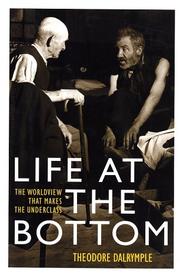
What I'm Reading Now - Life at the Bottom


Life at the Bottom: The Worldview that makes the Underclass


Dalrymple, Theodore
Ivan R. Dee, Chicago 2001
ISBN 9781566635059

Why I’m reading it:

I don’t recall where I first ran into this book; it may have come up in a Facebook conversation, or maybe someone at National Review referred to it. Anyway, I picked it up and was hooked right from the start. 

 What I think of it:

Dalrymple’s prose style really caught me. He pulls no punches and makes no apologies. At the same time, his compassion for the people he treats and chronicles is evident on every page. He points out the behavior that creates and contributes to the misery suffered by the patients at his hospital, and unsparingly identifies where the patients have done this to themselves, and where the supposedly sympathetic British intelligentsia have supplied them with foolish reasons for doing so.

Reading any of these essays produced the same effect for me. I found myself in each chapter thinking “Really? Can he be serious?  How did it get that bad?” Yes, he is serious, yes it is that bad, and Dalrymple, because he lives in the one world (the intelligentsia) and works in the other (the Bottom) he can see clearly how the two have influenced one another. Yet the two groups rarely come into direct contact, and despise each other in the concrete, no matter what airy theories (‘empowerment’, ‘diversity’ and the like) they espouse in the abstract. 

Will I finish it?

I already have. The book is a collection of twenty-two essays; each readable in a fifteen minute coffee break. Dalrymple is very easy to read, just hard to bear. 

Would I recommend it?

Only to someone who isn’t going to be easily depressed by the disheartening picture Dalrymple paints of life in lower class England. His indictment of fashionable liberalism will certainly sting anyone of that political bent. 

Gimme a quote:

“It is a mistake to suppose that all men, at least all Englishmen want to be free. On the contrary, if freedom entails responsibility, many of them want none of it. They would happily exchange their liberty for a modest (if illusory) security.”  This is the introduction to chapter one.