Powered By Blogger

Tuesday, September 1, 2015

What I'm Reading Now - Fundamentals for Liaisons


What I’m reading Right Now:
Fundamentals for the Academic Liaison, part of the ALA’s Fundamentals series. Written by Richard Moniz, Jo Henry, Joe Eshleman
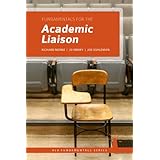

Why I’m reading it:
A big part of my job is to serve as liaison between the library and several academic departments. This academic year liaison work is getting more attention and priority from the library administration.

What I think of it:
It is well written, and each chapter covers a distinct aspect of the liaison librarian’s job. The chapters I’ve read so far all have a lot of useful information and suggestions, and very little fluff.

Will I finish it?
Yes. This is information I can put to use right away. One of the advantages of working for the library is that I can always renew or extend my book borrowing. Which is good, as I get to read this about 1/3 of a chapter a week.

Would I recommend it?
Yes, I would, particularly for new librarians. I don’t recall my MLS program covering liaison work, and if yours hasn’t, this book really is a must.

Gimme a quote:
“As a library liaison, prepare to become a master of communication. Communication is the key to establishing faculty relationships and those relationships lead to success as a liaison.” Chapter 3, p. 35

Friday, July 24, 2015

Educational Technology - Toys or Tools?

Probably it's some of both.

Stephen Bell discusses EduTech in his latest From the Bell Tower post. I'll be here when you get back from reading it.

Engage rant mode. 

Our library has its share of whiz-bang new technology. Our main library classroom, for example, has a  set of large monitors spaced around the room. Students can sit around the table by the monitor, and wirelessly connect their device to the monitor. The point of this is that when working on a group project, they can all be working on the same copy of the video, the document or picture, instead of emailing copies around the group and losing track of who's got the 'official' or 'final' version of the project.

At the front of the classroom are the big projection screens, attached to the monitor at the instructors stand. That computer has the same software as the big monitors, so that any group can pass their screen up to the projected screen and let the whole class see it. Multiple documents can be displayed at one time. 

That's great, but after two years with this stuff, I have yet to hear of any of the librarians using this technology in an Info Literacy or Reference Instruction session. It's not that we haven't been shown how to use the software; what hasn't happened is the opportunities for us as librarians to incorporate it into what we're trying to teach. A lot of us have very limited opportunity for teaching between faculty who don't ask very often, and faculty who ask us to cover only specific things.

Forgive me for sounding like an old Luddite, but I'm going to, a little. Why do we need this group project software in the library?  That's not where most classes meet, and certainly not on a regular basis, so the classes that are doing group projects don't get to use this very clever technology. 

We had a fellow from our campus Information Technology department come in to give us a lecture/presentation about using ed tech. His biggest point, which I could easily appreciate is that whatever level or amount of technology your library has available, the technology is still just a tool for the people doing the educating. People teach, technology assists. Technology does not teach anyone. This, I understand from an article Bell links to, is known as the Law of Amplification.

His second point was that when using ed tech, we should teach the method or process instead of  'how to use this device or software'. When I speak to classes about library research, I talk about the concepts that all database search interfaces share, not how to find articles in EBSCOHost.
"it’s a move away from an “I need the latest bright, shiny ed tech” mentality."
 Exactly.  In perusing the online literature and discussions of higher ed, I see/read a lot of searching for magic bullets, and an unhealthy dose of wanting to sound socially progressive and 'relevant' which often means uncritically embracing every new edu-fad and shiny technology that comes along.

I have listened for years to various higher education types both in and out of the library talk about the 'inevitability' of e-books overtaking and replacing print books. I'm still not convinced it's going to happen, and that it's going to happen within a generation. Perhaps I can point towards a few articles that show the continued viability of print, like this 
http://www.theamericanconservative.com/olmstead/save-the-print-library/

and this
http://www.infodocket.com/2014/10/18/winthrop-university-the-book-vs-e-book-e-book-survey-report/
  Or you can just take my word for it. This is of course far from conclusive, but at least it is clear I'm not alone in thinking that the techno-utopians who sigh for the death of the print book are going to be disappointed for some time to come.

Luddite moment over, everyone can relax.

Tuesday, July 14, 2015

What I'm Reading now - The Meditations


What I’m reading Right Now:
The Meditations of Marcus Aurelius, the Penguin Classics edition from 1964, translated by Maxwell Staniforth

 
Stoic philosopher, Roman Emperor

Why I’m reading it:

A friend of mine who teaches classics at a local private school suggested that I read it. 

Thursday, June 25, 2015

What I'm Reading Now - Private Armed Forces


Private Armed Forces and Global Security by Carlos Ortiz


Why I’m reading it:


I’m taking part in a writing collaboration project, my part of which concerns the activities of private military companies (PMCs). My own experience is with the formal US military, so I needed some background reading to get up to speed.
Not exactly the A-Team.

What I think of it:


It is a well-researched and compiled book, aimed at the academic or the consultant, not the general reader. The author starts by explaining the historical place of PMCs (a term he prefers to the more colloquial mercenary), and lays out what they look like in today’s world. The third part of the book presents the issues surrounding such forces – their relationships to states, non-state groups, international corporations & non-governmental organizations. PMCs have their supporters and their critics, and Ortiz tries to present all sides without taking sides.

Will I finish it?


I am not reading it cover-to-cover, I’m reading through several of the chapters looking for information on normative practice for PMCs.

Would I recommend it?


To someone who was studying modern conflicts and international law, yes. The writing style is academic and sort of dry; it is not a fun or fast read. However, as it’s not likely to be read as leisure reading, that’s not an issue. So no, it won’t make anybody’s list of titles for their next book club.

Gimme a quote:


(p. 48) “For the purposes of this book, I define PMCs as legally established international firms offering services that involve the potential to exercise force in a systematic way and by military or paramilitary means, as well as the enhancement, the transfer, the facilitation, the deterrence or the diffusing of this potential, or the knowledge required to implement it, to clients.”

Tuesday, June 23, 2015

RIP, Cynthia Hurd

The murderous attack on Charleston, SC churchgoers on June 17th has shocked and saddened the nation, but now I've learned another reason to be dismayed. My faith has lost brothers and sisters, and my profession has lost a longstanding member. According to an article at Inside Higher Ed, Cynthia Hurd was a librarian at a regional public library, and a part-time librarian at The College of Charleston. The IHE article quotes an open letter to the campus from the CoC president.

"She was a protector and lover of books and a fountain of knowledge whose loss will be felt by our entire college community,” he wrote. “Known for her quick wit and sense of humor, Cynthia connected with every person with whom she came in contact. She could relate to anyone, no matter who they were or where they came from. In that sense, she represented the very best of our college and our beloved Charleston."


Rest in Peace, Cynthia. May Light Perpetual shine upon you, and may your Memory be Eternal.