Powered By Blogger

Monday, June 8, 2015

What I'm Reading Now - Life at the Bottom


Life at the Bottom: The Worldview that makes the Underclass
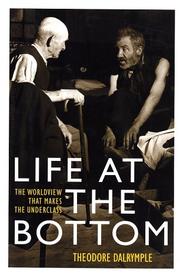

Dalrymple, Theodore
Ivan R. Dee, Chicago 2001
ISBN 9781566635059

Why I’m reading it:

I don’t recall where I first ran into this book; it may have come up in a Facebook conversation, or maybe someone at National Review referred to it. Anyway, I picked it up and was hooked right from the start. 

 What I think of it:

Dalrymple’s prose style really caught me. He pulls no punches and makes no apologies. At the same time, his compassion for the people he treats and chronicles is evident on every page. He points out the behavior that creates and contributes to the misery suffered by the patients at his hospital, and unsparingly identifies where the patients have done this to themselves, and where the supposedly sympathetic British intelligentsia have supplied them with foolish reasons for doing so.

Reading any of these essays produced the same effect for me. I found myself in each chapter thinking “Really? Can he be serious?  How did it get that bad?” Yes, he is serious, yes it is that bad, and Dalrymple, because he lives in the one world (the intelligentsia) and works in the other (the Bottom) he can see clearly how the two have influenced one another. Yet the two groups rarely come into direct contact, and despise each other in the concrete, no matter what airy theories (‘empowerment’, ‘diversity’ and the like) they espouse in the abstract. 

Will I finish it?

I already have. The book is a collection of twenty-two essays; each readable in a fifteen minute coffee break. Dalrymple is very easy to read, just hard to bear. 

Would I recommend it?

Only to someone who isn’t going to be easily depressed by the disheartening picture Dalrymple paints of life in lower class England. His indictment of fashionable liberalism will certainly sting anyone of that political bent. 

Gimme a quote:

“It is a mistake to suppose that all men, at least all Englishmen want to be free. On the contrary, if freedom entails responsibility, many of them want none of it. They would happily exchange their liberty for a modest (if illusory) security.”  This is the introduction to chapter one.


Thursday, May 14, 2015

It's the End of the Library as we know it . . . Again

Despite the click-bait title "Do We Need Libraries?", Stephen Denning of Forbes magazine is not predicting the impending obsolescence of libraries as has been done elsewhere. He's saying that libraries might become obsolete.

Doctor Who's "The Library" - why is it so quiet?

Tuesday, March 31, 2015

Wild Idealism vs Messy Reality. Again.


Home  

Well, Kevin Carey's book The End of College has certainly gotten a lot of attention over at Inside Higher Ed. As of today, I've read three essays discussing the book, or discussing the ensuing discussion of the book. Try to keep up, if you have the time.


This is where I came in: Barbara Fister's take, "No Libraries for You!"
https://www.insidehighered.com/blogs/library-babel-fish/no-libraries-you

Then there was this book review:
https://www.insidehighered.com/news/2015/03/23/kevin-carey-talks-about-his-new-book-end-college

Then Audrey Watters and Sara Goldrick-Rab wrote this:
https://www.insidehighered.com/views/2015/03/26/essay-challenging-kevin-careys-new-book-higher-education

and Matt Reed wrote
https://www.insidehighered.com/blogs/confessions-community-college-dean/public-matters-response-kevin-carey

Then Joshua Kim wrote
https://www.insidehighered.com/blogs/technology-and-learning/dear-kevin-5-challenges-%E2%80%9C-end-college%E2%80%9D
and
https://www.insidehighered.com/blogs/technology-and-learning/criticism-vs-attack

Goodness, what a kerfuffle!  As if that wasn't bad enough, somewhere along the line the conversation got derailed into a discussion about sexism and something called "mansplaining".  What that might be, perhaps someone can elighten me. It sounds a bit silly to me. I thought the discussion was about whether the University of Everywhere idea would fly or not?

How often has this happened, that somebody gets a good idea, and runs waaaaaay past practical reality in declaring it to be the Answer To All Our Problems? 

The part of all this that gets me the most is the naive assumption on Carey's part that the University of Everywhere "brand" will, any time soon, replace the cultural capital that established schools have in terms of potential employers putting faith in the UofE graduate's actual comprehension.  There's a reason people want to to to Harvard - its reputation carries weight. It will take a long time for the UofE to get anywhere near that kind of reputation. And every slacker who coasts or cheats his way through to his 'badge' or certificate will be a barrier to the UofE reaching that point.

Maybe the UofE concept that Casey describes will come about. It will just be long after his 4-year-old daughter has finished graduating from whatever college she ends up choosing to attend. 

The Power of Quiet

"When I tell people I identify as an introvert, they say, “How are you able to give speeches in front of 600 people and still consider yourself an introvert?” Introverts, I say, know how to “bring it,” or at least can learn when we have to. But it has a cost. Learning how to embrace your “inner extrovert” when you need to is necessary."
 Michael Stephens at Library Journal writes about the challenges and opportunities for introverts in the library world (hint: there are lots of us) in The Power of Quiet, on his blog Office Hours.

I am often times grateful for my office, which is tucked away in a staff area, far from the Maddening Crowds of students. An older office that I occupied for several years was directly off of a student casual seating area of the library, so I would often look out my door (it felt too stuffy to keep the door closed) and see a student watching me with curious interest. It was disconcerting to say the least. Among my memorable interactions with students in that office was:
  • The student who walked into my office, and then asked if she could use my microwave to reheat her coffee. I was discussing an issue with my supervisor, who was sitting right next to me, at the time. I let the student use the microwave. 
  • The student who got all the way into my office before realizing that this was not an available study room. My name plate on the wall and all my stuff posted on the door did not seem to register to him that the room was occupado
  • The string of students who wandered back and forth outside my door while talking loudly on their cell phones. 
By comparison, my new office is much less subject to interruptions. I do get phone calls from student workers, asking me to tackle a reference question that they're unsure about, and that's fine. Sometimes I cringe when the phone rings, if I feel like I can't handle talking to anyone; but I've got my "inner extrovert", or my professional face to get me through a tiring encounter. 


I don't claim to never need interaction; I really enjoy talking with our student workers, and learning about where they've come from and where they want to go. Maybe that's why they call me with the hard questions. However, I'm usually the one who initiates and ends the conversation, and I prefer to talk with students one on one. At staff meetings, whether student workers are involved or not, I tend to sit quietly and let people come and join me if they choose. If they do, thanks for enduring the meeting with me. If not, I'll be all right just the same.


What's your preference, in the thick of it, or towards the edge?


photo credit: <a href="http://www.flickr.com/photos/60141638@N06/8512104420">Hello My Name Is Introvert</a> via <a href="http://photopin.com">photopin</a> <a href="https://creativecommons.org/licenses/by-nd/2.0/">(license)</a>

Saturday, March 14, 2015

So Colleges Don't Need Libraries Now? Right.


Barbara Fister over at Inside Higher Ed quoted this NY Times piece on her blog Library Babel Fish. I decided to read the whole article ("College for a New Age") before I read Fister's take, so I could write my own take. The part that librarians took issue with was this:
“You don’t need libraries and research infrastructure and football teams and this insane race for status,” he says. “If you only have to pay for the things that you actually need, education doesn’t cost $60,000 a year.”
 So what to make of this? Well first of all I have to agree with Mr. Carey about a lot of what he is supposed to be saying in his book. College is way expensive, and something's gotta give. I expect that the college library was not even his main target in the book. The quote might have been chosen by the journalist writing the piece because talking about getting rid of libraries gets people upset, and therefore talking about the article.

"Only pay for things you actually need," he says. Unfortunately, at least in the article Carey does not elaborate on what he thinks you need to complete your education.  Call me biased, but I think that you do need a library to succeed in college.

The library as a place is often derided as a collection of dusty old books. Fair enough, it is hard to keep the average library dusted; books create dust. Books also have been for centuries the primary record format for the accumulated knowledge of Western Civilization, and the place where you can go to get access to that knowledge. It is a continual frustration to me that the urban legend endures that says 'everything is on the internet, and it's all free".  No, no it isn't. 

Most current scholarship is publicized in ways that do not include dumping on the Web for anybody to read. The Open Access movement is changing that, but right now, if you want current research and scholarly writing, you have to pay for it yourself, or get access through some organization that has paid for it and will allow you to look too. In other words, a library.  
 
As it was in 1890, so it is in 2015

Oscar Wilde said in An Ideal Husband that "information is the modern commodity". If you want to be educated today, you need access to information. Libraries have it, and we take some of the hassle out of finding it. We'll even help you find it, or find it for you. 

A few other points

Not all colleges are focused on 'research'. Lots of schools still focus on teaching and the liberal arts. My school self-describes as a teaching university. The big research schools are a small proportion of all the colleges/universities in the United States. 

The article says that Carey explored online learning as an alternative to the traditional classroom model. Good for him. He is reported as saying his online class was a better experience than if he had sat in a classroom with the professor (who teaches at MIT). Well, that's nice, but it is pure speculation. He hasn't taken a residential class with this professor, so he has nothing upon which to build his comparison. Oh, and by the way, I work with professors who teach online classes as well as residential, and they want their students to use the library. How else are their students going to get the current scholarship?
They get it here. Of course.

I agree we do not need any more big, fancy football teams and stadiums. They are supposed to be money-makers, but that's not what college is about. 

It is probably true that in the future there will be other venues for certification and credentials that employers will accept. But you have to get the business world, which is also encumbered by cultural habit, to change its employment practices (like the resume, a bureaucratic dinosaur) before that can happen. And that's outside the world of higher education. We'll change more readily when the business world says they want it. 

There, that's my two bits. Now I'm going to go read Fister's take on it. Read it here, then tell me what you think about it.