The usually library-related musings of an academic librarian, father, writer and Orthodox Christian, when he finds the time in between trips into the stacks to look for books to read.
Maybe. I've recently signed up to get The Critic's Notebook, "Weekly recommendations from the editors of The New Criterion on what to read, see, and hear in the world of culture."
This week they recommend that I get tickets to the Metropolitan Opera to watch Maria Stuarda, which I'm guessing is about Mary Stuart, queen of England, better known as Mary Queen of Scots.
Obviously this is from before she gets her head cut off.
I am not a fan of opera; but I'm not opposed to it either. The Broadway musical Phantom of the Opera is about as close as I get to opera most of the time, but I (and you) should be willing to give it a try. Here's a video still from the Met's website:
I can't get the video to work, so follow the link at the top and scroll down to it. Or try this YouTube video. Because Western Culture is worth celebrating.
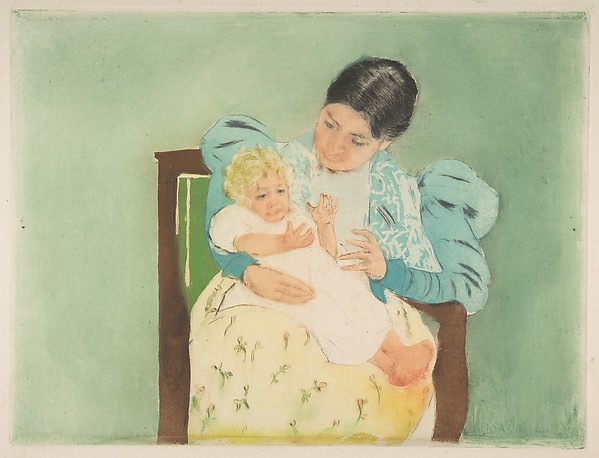
The Metropolitan Museum of Art is offering rights-cleared access to over 400,000 digital images of objets d'art in their collection. Works that are covered by the new policy are identified on the Museum’s website (http://www.metmuseum.org/collections) with the acronym OASC. Like this one:
Mary Cassatt's The Barefoot Child
And yes, they have works that are not the product of Western Civilization. Because we should enjoy them as well. Read the full announcement here:
OASC was developed as a resource for students, educators,
researchers, curators, academic publishers, non-commercial documentary
filmmakers, and others involved in scholarly or cultural work. Prior to
the establishment of OASC, the Metropolitan Museum provided images upon
request, for a fee, and authorization was subject to terms and
conditions. Additional information and instructions on OASC can be found on the Museum’s website at http://www.metmuseum.org/research/image-resources/frequently-asked-questions.
The civilization most concerned with property rights is also concerned about sharing the results of creative work. Because Western Civilization should be shared and celebrated.
Wolfgang Amadeus Mozart composed Eine Kleine Nachtmusik (A Little Night Music) in 1787.
You may be cool, but you're not "my first name has Wolf in it" cool.
Eine Kleine Nachtmusik is the byname of Serenade No. 13 in G Major, K 525,
serenade for two violins, viola, cello, and double bass by Wolfgang Amadeus Mozart,
admired for its lively, joyful quality and its memorable melodies. The
piece was completed on August 10, 1787, but was published posthumously.
In present-day practice, it is typically performed in orchestral
arrangement.
Mozart produced many serenades, the 13th of which, nicknamed EinekleineNachtmusik, is his best known. The four-movement work opens with a bright allegro in sonata form, and a slow, lyrical second movement follows. The third movement is a light minuet, and the finale is a brisk rondo. Originally, the piece contained a second minuet, but that movement has been lost. The specific occasion, if any, for which EinekleineNachtmusik was composed has never been determined.
Because Western Civilization has some of the greatest works of art mankind has ever known.